
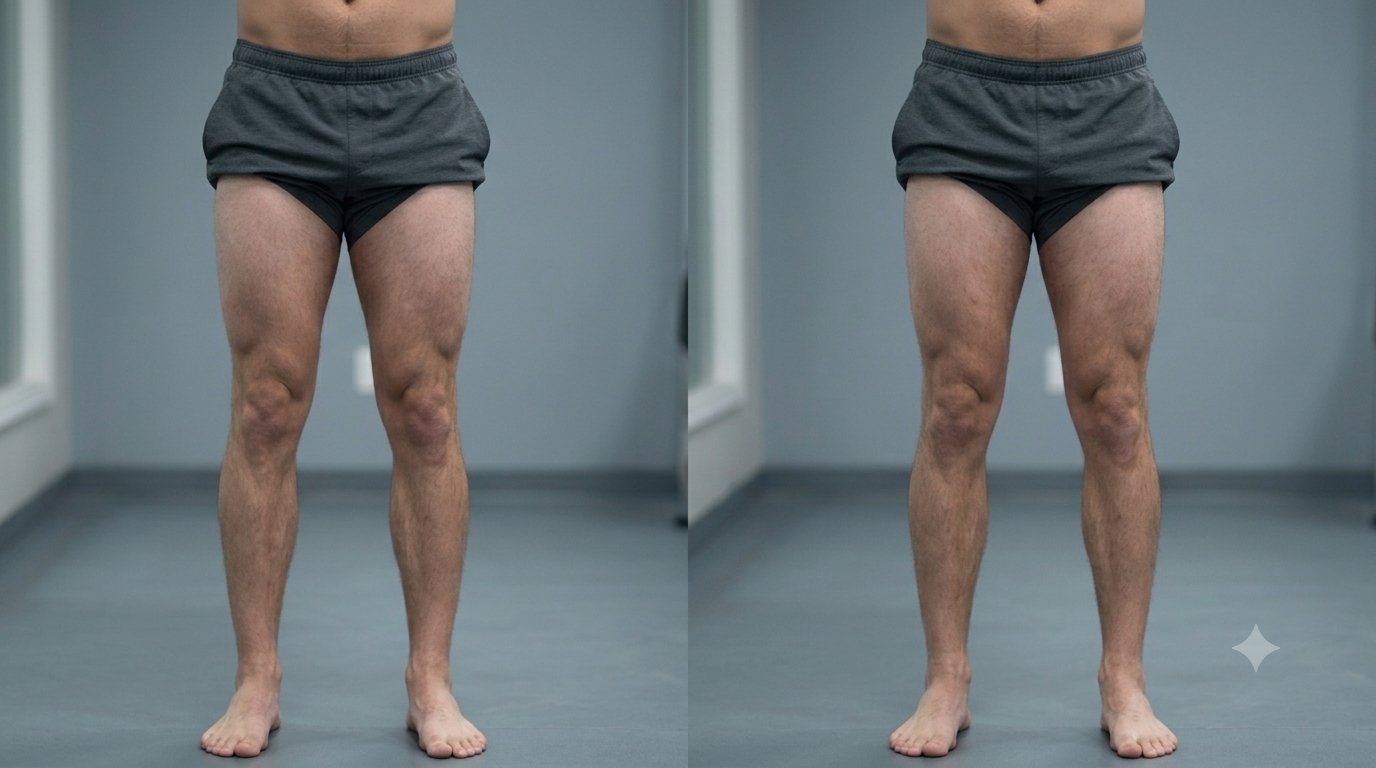
The Landing Error Scoring System (LESS) is a field test of jump-landing technique. It was developed by Darin A. Padua and colleagues at the University of North Carolina at Chapel Hill and published in the American Journal of Sports Medicine in 2009, as part of the JUMP-ACL study of military academy cadets.
Why it was developed
Injuries such as anterior cruciate ligament (ACL) tears often happen during landing. Laboratory motion analysis can measure landing mechanics in detail, but it is expensive and slow. The LESS was designed as a simple clinical tool to identify people whose landing technique shows potentially high-risk patterns.
How the test is done
- The person stands on a box about 30 cm high.
- They jump forward to land at a set distance in front of the box.
- On landing, they immediately jump straight up as high as possible.
- Two standard video cameras record the landing, one from the front and one from the side.
What is scored
A rater reviews the video and scores a checklist of landing "errors". These include, for example, limited knee or hip flexion at initial contact, knee valgus (the knee moving inward), an upright trunk, landing flat-footed or on the heels, an asymmetrical foot contact, and a stiff landing with little overall movement.
How to read the score
Each error adds to the total, so a higher score means poorer landing technique. The score describes movement quality; it does not, on its own, predict whether a particular person will be injured. It is most useful for screening groups, guiding training, and tracking change over time.
LESS in teaching
Because it uses ordinary video and a clear checklist, the LESS is well suited to physiotherapy and sports-science teaching. Our Rollaxis software includes a landing assessment based on the LESS, which estimates the items from marked video frames and shows students how each item is judged.
Reference: Padua DA, Marshall SW, Boling MC, Thigpen CA, Garrett WE Jr, Beutler AI. The Landing Error Scoring System (LESS) is a valid and reliable clinical assessment tool of jump-landing biomechanics: the JUMP-ACL study. Am J Sports Med. 2009;37(10):1996–2002.
More articles
The eight phases of gait: a clinician’s map
The Rancho Los Amigos phases, what each joint should be doing, and why the language matters when you write up a gait assessment.
Filming gait with a phone: a simple setup for students
How to record walking video that is good enough to measure joint angles: walkway, camera height, distance, markers and lighting.
Forward head posture and the craniovertebral angle
How to measure the craniovertebral angle from a side photograph, and how to read the number carefully.
Talk to the academy
Questions about a course, a workshop for your institution, a Rollaxis demo or a consultation? Email us and we will reply within working hours.