
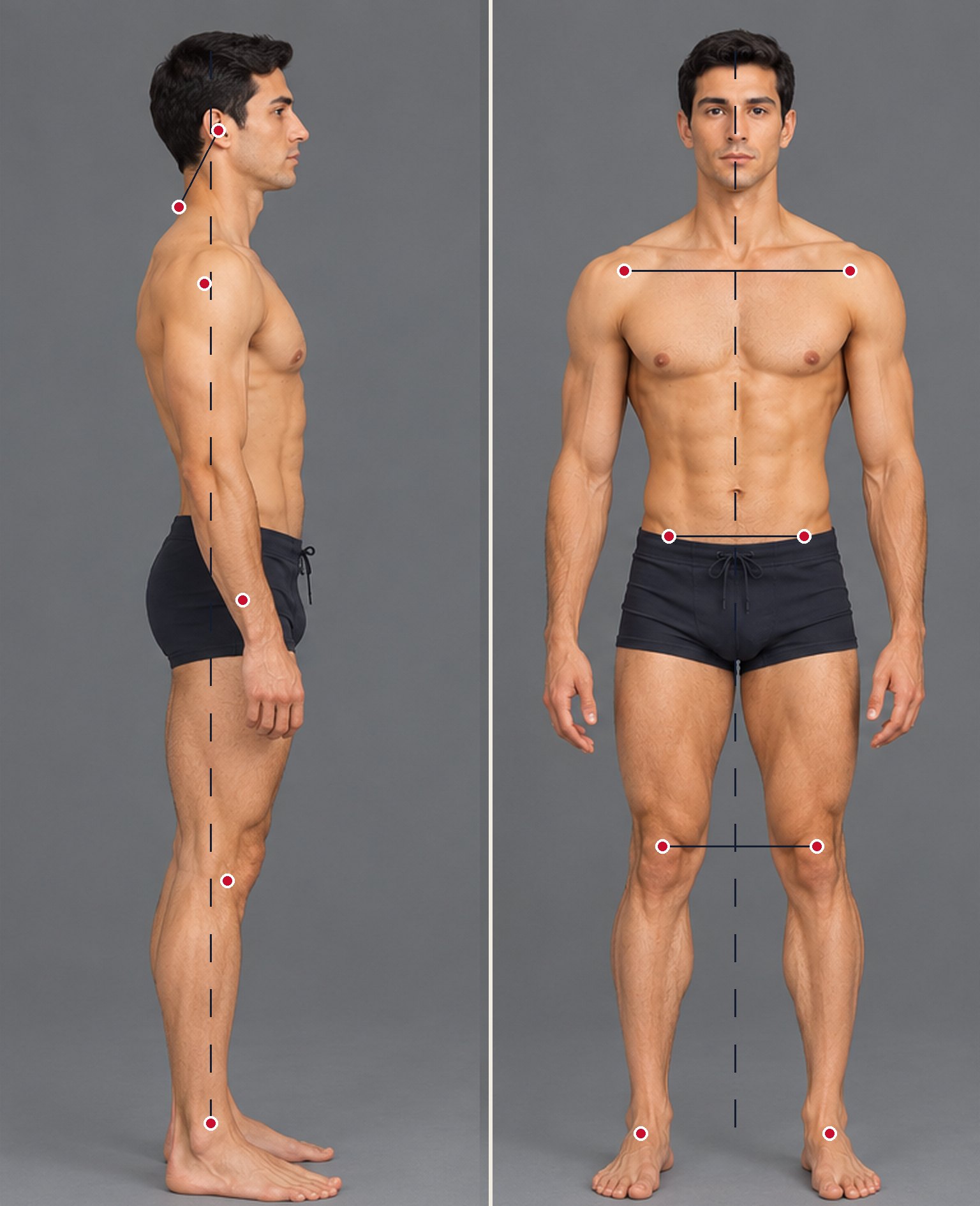
Forward head posture is one of the most common things physiotherapists are asked about, especially by students and desk workers. It is easy to see by eye, but much harder to describe consistently. The craniovertebral angle (CVA) gives us a simple number to work with.
What the craniovertebral angle is
The CVA is the angle between a horizontal line through the spinous process of the seventh cervical vertebra (C7) and a line from C7 to the tragus of the ear. When the head moves forward relative to the trunk, the angle becomes smaller.
How to take the photograph
- Place a small marker on the C7 spinous process and another on the tragus.
- Put the camera on a tripod at shoulder height, level, and at right angles to the person.
- Ask the person to stand relaxed and look straight ahead. Take a few photographs and use a typical one, or the average of several.
Reading the number
Studies use different cut-off values, but an angle of roughly 50° or more is often treated as typical, with smaller angles suggesting a more forward head position. Our Rollaxis posture analysis uses a reference of 50° or more, and lets the user change the reference value and its source.
Be careful with conclusions
A single photograph shows one moment. Posture changes with fatigue, mood, the task and even the camera position. The link between CVA and neck pain is not consistent across research. Treat the angle as one piece of information: useful to describe posture and track change, but not a diagnosis on its own.
In teaching
Measuring the CVA is a good first exercise for students because it combines palpation, careful photography and interpretation. It also shows how small changes in method, such as a tilted camera, change the result.
More articles
The Landing Error Scoring System (LESS): what it measures and how to score it
A practical walk-through of the jump-landing test used to screen for high-risk landing technique.
The eight phases of gait: a clinician’s map
The Rancho Los Amigos phases, what each joint should be doing, and why the language matters when you write up a gait assessment.
Filming gait with a phone: a simple setup for students
How to record walking video that is good enough to measure joint angles: walkway, camera height, distance, markers and lighting.
Talk to the academy
Questions about a course, a workshop for your institution, a Rollaxis demo or a consultation? Email us and we will reply within working hours.