
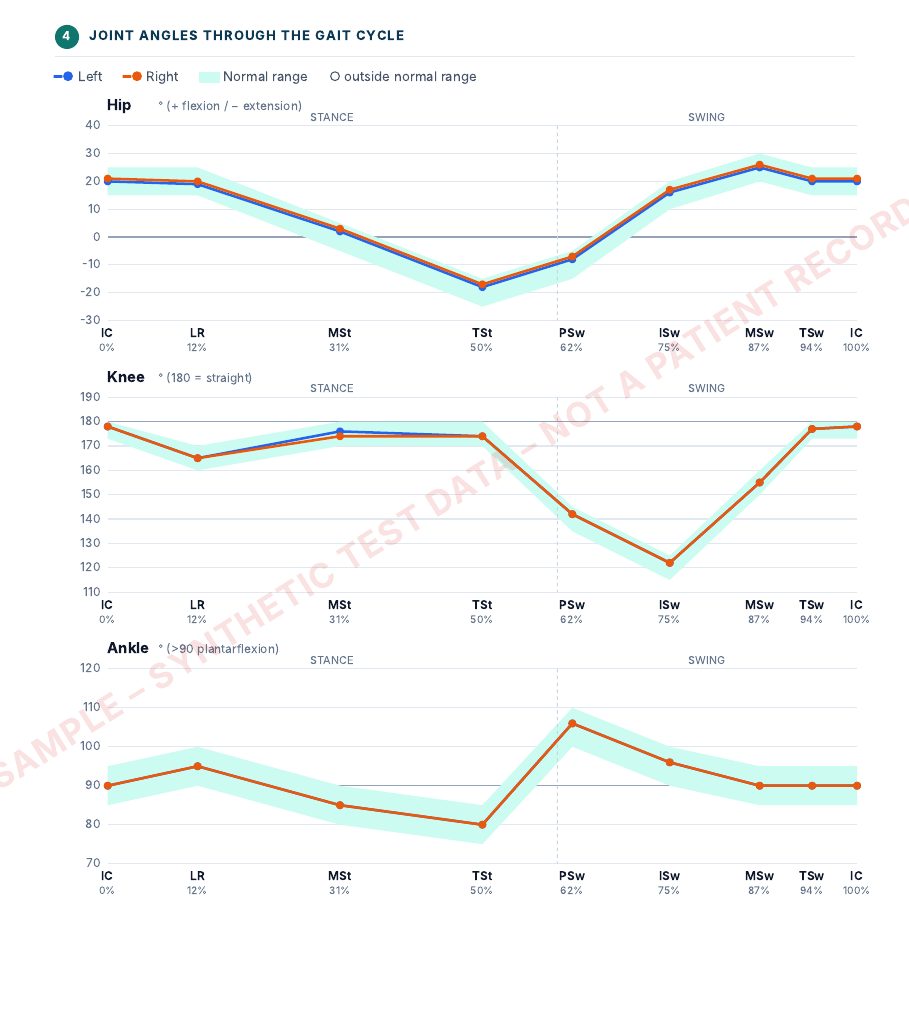
When students first watch someone walk, they see one smooth movement. To assess gait, we need to break that movement into parts that can be named, observed and measured. The most widely used system is the one developed at Rancho Los Amigos Medical Center in California by Jacquelin Perry and colleagues.
The gait cycle
A gait cycle runs from the moment one foot touches the ground to the next time the same foot touches the ground. At a normal walking speed, about 60% of the cycle is stance (the foot is on the ground) and about 40% is swing (the foot is moving forward through the air).
The eight phases
- Initial contact (0%): the moment the foot touches the ground.
- Loading response (about 0–10%): body weight is accepted onto the limb and the knee flexes a little to absorb the shock.
- Mid stance (about 10–30%): the body travels over the stationary foot while the other leg swings.
- Terminal stance (about 30–50%): the heel rises and the body moves ahead of the foot.
- Pre-swing (about 50–60%): the second double-support period; weight moves to the other limb and the toes push off.
- Initial swing (about 60–73%): the foot lifts off and the knee flexes to clear the ground.
- Mid swing (about 73–87%): the limb advances until the tibia is vertical.
- Terminal swing (about 87–100%): the knee extends and the limb prepares for the next contact.
Three tasks, not just eight names
The phases group into three functional tasks: weight acceptance (initial contact and loading response), single-limb support (mid stance and terminal stance) and limb advancement (pre-swing and the three swing phases). Thinking in tasks helps you ask the right clinical question: is this person struggling to accept weight, to support it, or to move the limb forward?
Why “initial contact” and not “heel strike”
Older textbooks used terms such as heel strike and toe off. The Rancho terms describe what happens in every patient, including those who land flat-footed or on the forefoot. Writing “initial contact with the forefoot” is more precise than saying heel strike is absent, and it keeps your reports consistent.
Measuring the phases
In our Rollaxis software, the walking analysis uses these eight phases on both sides, so students mark the same events every time and compare the joint angles with published reference values.
Reference: Perry J, Burnfield JM. Gait Analysis: Normal and Pathological Function. 2nd ed. Thorofare, NJ: SLACK; 2010.
More articles
The Landing Error Scoring System (LESS): what it measures and how to score it
A practical walk-through of the jump-landing test used to screen for high-risk landing technique.
Filming gait with a phone: a simple setup for students
How to record walking video that is good enough to measure joint angles: walkway, camera height, distance, markers and lighting.
Forward head posture and the craniovertebral angle
How to measure the craniovertebral angle from a side photograph, and how to read the number carefully.
Talk to the academy
Questions about a course, a workshop for your institution, a Rollaxis demo or a consultation? Email us and we will reply within working hours.