
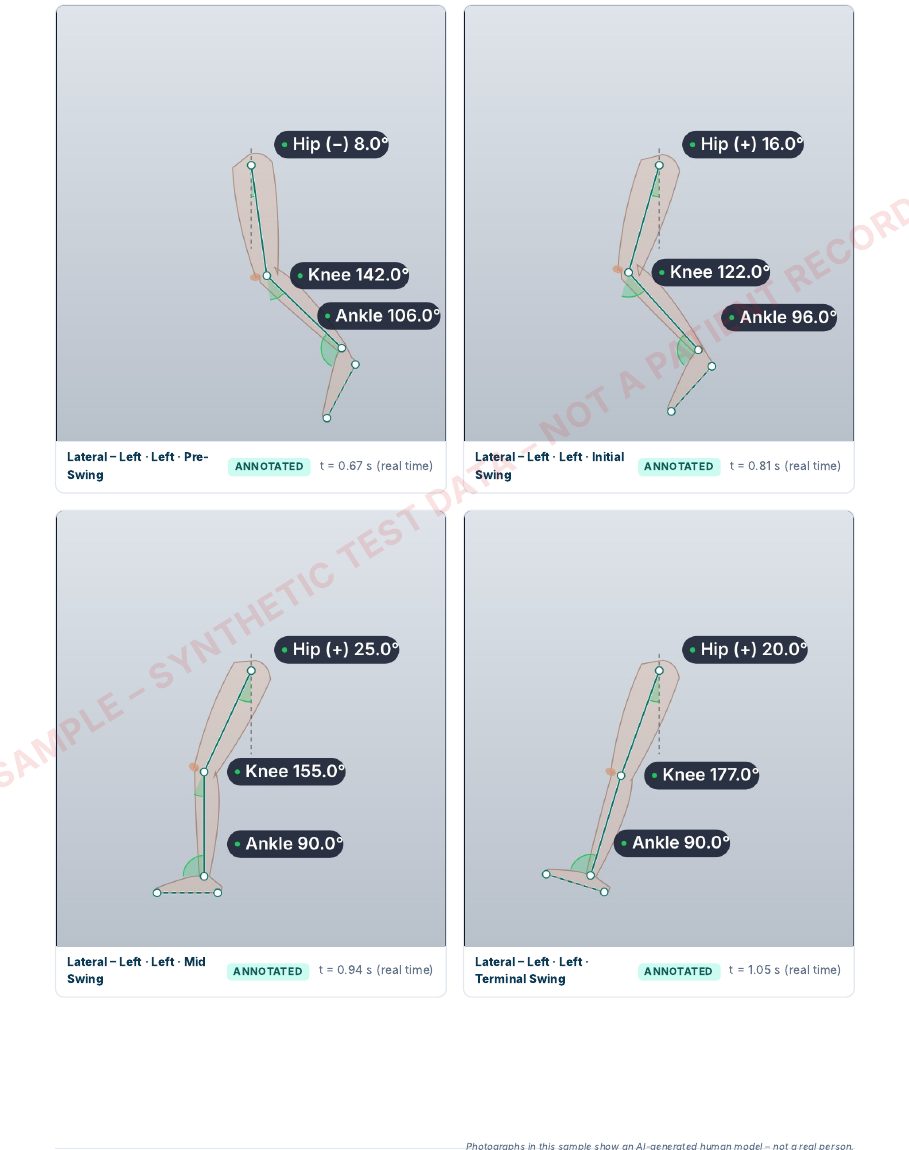
Every physiotherapy student is taught to observe movement: to watch a patient walk, squat or land and notice what looks wrong. Observation is an essential skill. But it has limits, and understanding those limits is part of becoming a good clinician.
What the eye misses
Movement is fast, and small differences of a few degrees are hard to see. Two observers can watch the same person and disagree. The same observer may judge differently on another day. Without a measurement, it is also difficult to show whether a patient has really changed after treatment.
What measurement adds
- Objectivity: an angle is the same number whoever reads it.
- Comparison: measurements can be compared with reference values and with the other side of the body.
- Progress: repeated measurements show whether treatment is working.
- Communication: numbers and marked images make findings easy to explain to patients, coaches and colleagues.
Learning to reason, not only to measure
Measurement is not a replacement for clinical reasoning. A number only becomes useful when the clinician asks why it is there and what it means for the person in front of them. That is why we teach both together: careful observation, accurate measurement, and the reasoning that links them.
This idea is at the heart of Rolling Joints Academy, and it is why we built Rollaxis: to give students a simple way to see the angles behind what they observe, and to discuss them with evidence.
More articles
The Landing Error Scoring System (LESS): what it measures and how to score it
A practical walk-through of the jump-landing test used to screen for high-risk landing technique.
The eight phases of gait: a clinician’s map
The Rancho Los Amigos phases, what each joint should be doing, and why the language matters when you write up a gait assessment.
Filming gait with a phone: a simple setup for students
How to record walking video that is good enough to measure joint angles: walkway, camera height, distance, markers and lighting.
Talk to the academy
Questions about a course, a workshop for your institution, a Rollaxis demo or a consultation? Email us and we will reply within working hours.